

Tiny Home Setup Made Simple
How to Prepare Your Property for a Park Model RV Tiny Home
This guide covers everything you need to do to get your property ready for delivery - ground prep, setting and leveling, utility hookups, and recommended contractors.
For production timelines, delivery coordination, and what happens from order to move-in, visit our Delivery & Setup page. If your home is arriving soon, see our Delivery Day Checklist for what to expect on arrival day.
Watch: Property Prep Explained
This short video walks through everything covered in this guide. Watch first, then use the steps below as your reference.
Do not want to find contractors yourself? We list the companies we use and trust for site prep, setting and leveling, electrical, plumbing, propane, and more at the bottom of this page, for both the Portland and Snohomish areas.
See Our ContractorsGround Preparation & Site Surface
Before delivery, the site must be prepared to support the weight of the park model and allow for proper leveling. Bare dirt or soft ground is possible but not recommended - it compresses unevenly, traps moisture, and causes the home to settle or shift over time.
Common Site Prep Options
- Compacted gravel or crushed rock - A 5-8 inch thick, fully compacted base is the most common option. Proper compaction is critical to prevent settling under the home's weight over time.
- Concrete pad - A poured concrete pad provides a very stable long-term surface and is a good option when site conditions allow.
- Engineered surfaces - Depending on terrain, soil type, and drainage, other solutions may be appropriate. Your setting contractor can help determine the best option for your specific site.
Setting & Leveling the Home
After delivery, the home will be set and leveled using block setting on concrete blocks or pier setting on metal piers. This is done by specialists and is something we can help schedule when you order your home.
Proper setting and leveling directly affects how the home feels, how systems function, and how the structure holds up over time. A home that is not properly supported can experience door and window alignment issues, floor flex, frame stress, and the need for early re-leveling.
What Setting Includes
- Supporting the frame at designated load points
- Leveling the home side-to-side and front-to-back
- Removing transport stress from the chassis once placed
- Creating a stable base that resists settling over time
Blocks or Piers: The Two Ways It Gets Done
Two systems do the actual supporting, and both are solid. Most sites use one or a mix of both. The right fit comes down to your lot, the height of the home, the soil, and local code. A good installer matches the method to the job.


Concrete blocks
- Proven, and still the most common method
- Very strong straight down, and won't rust
- Cheap, available, and shimmed tight by hand
Metal piers
- Adjustable by design, re-level by turning the head
- Engineered with a rated load capacity
- Fast, and built for height and bracing
Depending on location, wind exposure, and local requirements, additional stabilization such as tie-downs or anchoring may be recommended. These measures reduce movement in high-wind areas and improve long-term stability.
Want the full breakdown?
How each method works, what a proper set costs, and why it protects your warranty.
Skirting
Skirting closes the gap between the ground and the bottom of the home. It cleans up the look, hides blocks or piers, protects plumbing and wiring, and reduces drafts under the floor.
- Material options: vinyl, metal, engineered wood, composite, or insulated systems
- Add vents or a vented access door for airflow and service access
- Lay a ground moisture barrier when possible
- Seal around utilities and maintain clearances to siding
Stairs
Park Model RVs sit slightly elevated once leveled, so stairs are required for entry. Stairs are not included in the base price of the home - they are added after installation since site conditions and stair styles vary widely.
Most setups require 3 to 4 steps depending on how the home is leveled. Common options include basic wood stairs, pre-made metal steps, or custom composite systems. If you would like help, our team can assist with building stairs and the cost can be added to your home invoice.
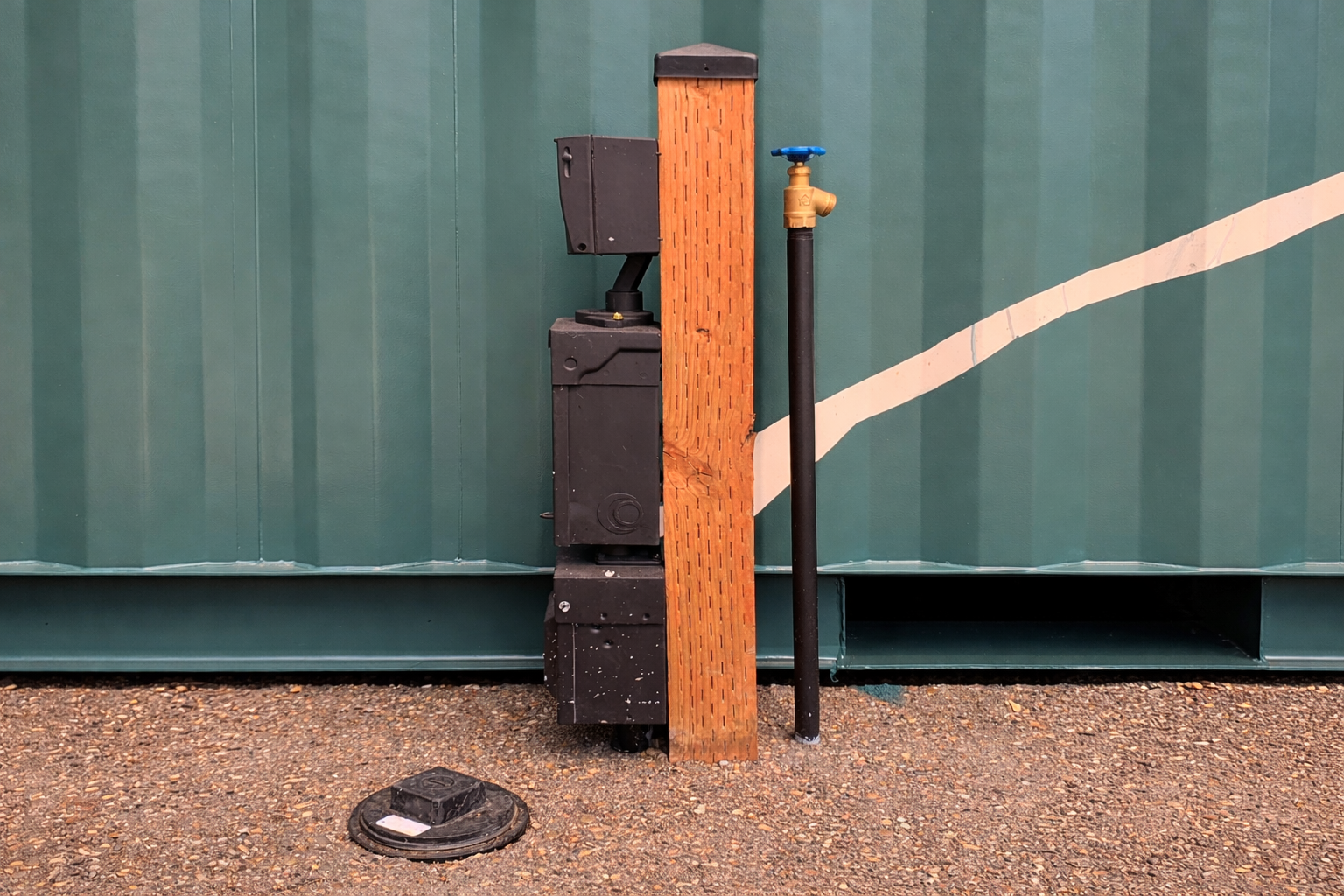
Example of 3 of the 4 RV style utility hookups. Sewer on the left, 50 amp electric in the middle, and water connection on the right.
Utility Hookups
Connecting utilities is usually simpler than people expect. Park Model RVs use standard RV-style hookups that most licensed professionals are already familiar with. These homes are RVIA Certified ANSI 119.5 Park Model RVs and just need traditional RV connections. If you need a referral, our recommended contractors are listed below.
Electrical
A licensed electrician will install a standard 50-amp, 120/240V, 4-prong RV outlet, or hardwire the connection if required. We perform an amperage load calculation based on your selected options. Homes with higher-demand appliances such as electric ranges or electric dryers may require 100-amp service - your order summary will confirm what you need.
Ask for:
- 50 amp, 120/240V, 4-prong RV hookup or 100 amp service depending on the home's load
- Weather-resistant RV pedestal or disconnect near the home
- Shore power connection compatible with a Park Model RV
Water
Water service can be as simple as a standard hose-size connection or a direct water line tied into the home. A shut-off valve near the home is recommended for easy access.
Ask for:
- Standard RV-style water connection to city water or an approved well
- Shut-off valve installed near the home
Sewer & Septic
Waste connections tie into an existing sewer line or septic system using an RV-style connection. Local permits may be required depending on jurisdiction. This is not a full residential plumbing system - connections are RV-style and remain serviceable and accessible.
Ask for:
- RV-style sewer connection tied into the existing sewer mainline or a septic system approved for RV use
- Standard RV waste inlet compatible with Park Model RVs
Gas & Propane
Homes built with gas ranges can use natural gas or propane. Propane setups use the manufacturer-included conversion kit found in the owner's manual.
Ask for:
- Propane tank installation and hookup for a Park Model RV
- Connection to range, oven, or other propane appliances
- Pressure testing and final hookup after placement
- Conversion using the kit included with the home
Recommended Contractors
You do not need a specialty crew for most of this. Any licensed electrician or plumber can handle a Park Model RV hookup, and any competent excavation outfit can build a gravel pad. The connections are standard RV-style work.
The companies below are the ones we use and trust. They already know these homes, they have done this work with our customers many times, and the jobs go smoothly. Hire them or hire your own. Either way, the "Ask for" lists above tell your contractor exactly what to quote.
Tap a category below to see who we recommend.
Site Prep, Gravel Pads & Excavation
DemoXterior
Services: Site clearing, grading, gravel and crushed rock pads, drainage, demolition, and general property prep
Service Area: Oregon & SW Washington
Website: demoxterior.com
Phone: 503-956-5812
Email: DemoXterior@gmail.com
Dust Devil Excavation
Services: Excavation, grading, gravel and crushed rock pads, and site prep
Service Area: Portland Metro & surrounding Oregon
Contact: Sergey Fedotov, Owner and Operator
Website: dustdevilexcavation.com
Phone: 503-333-5919
Email: sales@dustdevilexcavation.com
Oregon CCB License: 258791
Foresons Site Services
Services: Site prep, gravel and crushed rock pad prep, grading, and excavation
Service Area: Snohomish County & surrounding Washington
Contact: Jim Billings
Phone: 425-737-0974
Email: foresons@outlook.com
WA Contractor License: CC FORESSS740JH
Setting, Leveling & Tie-Downs
NWT Setting
Services: Block setting, pier setting, re-leveling, stair building, and skirting
Service Area: Oregon only
Email: info@nwtinyhomes.com
Re-Leveling Pros / On Level Services
Services: Block setting, pier setting, Diamond Pier Setting for permanent foundation, re-leveling, foundations, tie-downs, earthquake bracing, skirting, and more
Service Area: Oregon, Washington, Idaho, Colorado
Website: relevelingpros.com
Email: jenny@relevelingpros.com
Electrical
Alameda Electric
Service Area: Oregon & Washington
Our primary point of contact for Park Model RV electrical setups. Garrett and the team specialize in coordinating these projects.
Website: alamedaelectricpdx.com
Phone: 503-863-6887
Email: info@alamedaelectricpdx.com
Daybreak Electric
Service Area: Snohomish & King Counties
Contact: Chason France, Owner. Ask for Chason when you call.
Website: daybreak-electric.com
Phone: 425-686-0858
Email: chason@daybreak-electric.com
Switch Electric Home Energy
Services: Electrical service and hookups, plus solar, battery backup, off-grid systems, EV chargers, and generators
Service Area: Snohomish, Skagit & Island Counties, including Snohomish, Monroe, Lake Stevens, Marysville, Arlington, and Everett
Contact: Tyler Keezer, President
Website: myswitchelectric.com
Phone: 425-244-5511
Email: tyler@myswitchelectric.com
Plumbing & Water
Blackcat Plumbing
Service Area: Oregon only
Website: blackcatplumbing.com
Phone: 503-788-0300
Email: info@blackcatplumbing.com
We have not worked with a plumber in the Snohomish area yet, so we do not have one to recommend. We will add one here once we do. In the meantime, any licensed plumber can make an RV-style water and sewer connection. Use the "Ask for" list above when you call for a quote.
Propane
General Contractor
Midgard Construction / Epic
Services: General contracting, decks, porches, and site work around the home
Service Area: Snohomish County & surrounding Washington
Phone: 206-785-8383
Email: epic@midgard.construction
Gutters & Exterior Cleaning
MacGyver 4 Hire
Services: Seamless aluminum gutters and downspouts, gutter cleaning and screens, soft wash roof and siding cleaning, window washing, and pressure washing
Service Area: Snohomish, King, Skagit & Island Counties
Website: macgyver4hire.com
Phone: 425-923-4044
Questions? We Are Here to Help.
We handle transport coordination and can connect you with contractors who specialize in Park Model RV setups. If you have questions or want help planning your property prep, reach out anytime.
